Choosing a technology stack is a business decision dressed up as an engineering one. The tools you pick affect how quickly you can launch, what it costs to hire, how painful the first year of changes will be, and whether the product can still be maintained when the original developers have moved on.
This guide is written for founders and operators, not for a framework debate. The useful question is not “what is popular in 2026?†It is “what can we ship, support, and grow without painting the company into a corner?â€
Start with the business, not the tools
Write down the product in operational terms before anyone names a language. Who uses it? What jobs must it complete in the first release? Which parts are the actual product, and which parts are admin, reporting, or billing around the edges?
Those answers matter more than a list of frameworks. A marketplace, a B2B workflow tool, a consumer mobile app, and an internal operations system all look like “software,†but they pull you toward different stacks. If you skip this step, the team will default to whatever they already know — which is fine only when that experience matches the product.
Questions worth answering first
- Who is the first paying customer, and what must work for them on day one?
- Is this a marketing site with a small application behind it, or a product people live in every day?
- Do you need native mobile apps, a responsive web app, or both?
- Which systems must it connect to — payments, accounting, CRM, messaging, identity?
- Are there industry rules around data, audit logs, or where information can be stored?
- How large is the team that will own this after launch — and what skills can you actually hire?
MVP versus the product you will still own in two years
An MVP should prove that customers will use and pay for a focused version of the idea. It should not pretend to be the final architecture. The mistake is treating “move fast†as permission to ignore how the next twelve months of change will land.
For most startups, that means:
- Keep the first release small enough to finish.
- Choose mainstream tools so you can hire and find documentation.
- Avoid exotic infrastructure until you have a real traffic or compliance reason.
- Leave room to add a second app, a second region, or a heavier reporting layer later.
If the MVP is clearly a throwaway experiment, say so. If it is the foundation of the company, budget a little more design and testing up front. Softlance often starts with a short discovery pass so the MVP and the longer-term product are not fighting each other. You can see how we approach that on our custom software development page.
Frontend: what customers actually touch
The frontend is the product as far as users are concerned. Choose it based on the interface you need and the team who will maintain it.
React is a practical default for web applications and SaaS dashboards: large hiring pool, lots of libraries, and a path into mobile with React Native if you later need apps. It is not automatically the right choice for a content-heavy marketing site.
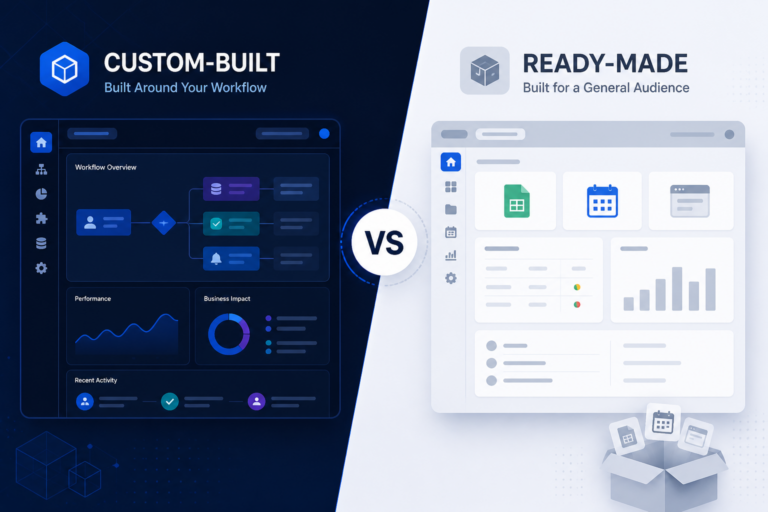
A WordPress (or similar) site plus a separate application is often the right split when you have a public website that marketing will edit, and a signed-in product that should not live inside the CMS. Our website development work covers the public site; the product itself usually belongs in an application stack.
If the business is mobile-first — field teams, consumer apps, stores that live in an app store — plan the mobile client as a first-class surface, not a thin wrapper added at the end. See mobile app development for how we think about iOS, Android, and shared code.
What to avoid: picking a frontend because a blog called it modern, then discovering nobody on the team can ship a release without a specialist.
Backend: where the rules of the business live
The backend holds accounts, permissions, payments, and the workflows you cannot afford to get wrong. Founders should care about three things: speed to a solid first version, cost of people who can maintain it, and whether it can grow without a rewrite.
Laravel (PHP) is a strong fit for business applications, admin tools, and many SaaS products. It is explicit, well documented, and widely used for CRMs, portals, and operational systems. If your team already ships WordPress, PHP skills transfer more easily than a jump into an unfamiliar ecosystem.
Node.js is a common choice when the product is real-time, JavaScript-heavy, or you want one language across frontend and backend. It is not magically cheaper. You still need discipline around structure, testing, and how you store data.
Django (Python) is often the right call when the product is data-heavy, needs a serious admin early, or will grow into reporting and machine-learning work. Python also helps if your hiring plan already includes analysts or data people.
There is no prize for mixing all three. Pick one backend for the core product unless you have a clear reason to split a service out later.
Database: match the shape of the data
Most business products start well on a relational database (PostgreSQL or MySQL). Tables, transactions, and reporting are what invoices, bookings, inventory, and permissions actually look like.
Document stores and specialised search tools have a place, but they are usually an addition, not the first place you put customer and money data. If someone proposes a database because it is fashionable, ask what query or report it makes easier — and what it makes harder when finance wants a clean export.
Plan backups, staging data, and who can access production from day one. That is cheaper than bolting it on after the first incident.
Scalability, without the science project
You need a stack that will not collapse at the first spike, and you do not need a platform designed for a company ten times your size. Sensible defaults: one well-structured application, a managed database, caching where pages or APIs are hot, and a host you can actually operate.
Scale the parts customers feel — slow screens, timeouts, report jobs that lock the database — when you have evidence. Premature microservices usually slow a small team down.
Security as a product requirement
Security is access control, updates, secrets, backups, and how you handle personal data. It is not a logo on the homepage.
Whatever stack you choose, insist on: hashed passwords and a real login flow, role-based access, HTTPS, dependency updates, and a clear list of who can reach production. If you take payments or store sensitive records, say so in discovery so the architecture and hosting match that risk. A custom build does not make you secure by default; a packaged tool does not either. Someone has to own the controls.
Cost, time to market, and who will maintain it
Development cost is mostly people-time. A familiar, boring stack is often cheaper because the team spends days on the product instead of on plumbing. A rare stack can look elegant and then stall when you need a contractor in a hurry.
Time to market improves when you reuse proven libraries for auth, billing, email, and file uploads instead of inventing them. It gets worse when the stack is new to everyone in the room.
Maintenance is the part founders underestimate. Ask: who can ship a fix in six months? If the answer is “only the original freelancer, if they pick up the phone,†the stack is a business risk. Mainstream Laravel, Django, Node.js, and React code is easier to hand over than a clever one-off.
Team availability
Hire for the stack you can staff in your city and timezone, or with a partner who already works that way. Laravel and React developers are widely available. Niche languages can be the right technical choice and still be the wrong company choice if you cannot replace a person on leave.
If you do not have an in-house team yet, choose tools a product studio can support without a six-week ramp. That is one of the reasons we standardise on proven application stacks for software development rather than inventing a new one per project.
When Laravel, Django, Node.js, or React is a reasonable default
Use this as a starting point, not a rulebook:
- Laravel — business apps, portals, admin-heavy SaaS, teams comfortable with PHP, products that look like operations software.
- Django — data-centric products, strong built-in admin, Python already in the company, reporting-heavy roadmaps.
- Node.js — JavaScript-wide teams, real-time features, APIs that sit next to a React frontend.
- React — interactive web apps and dashboards; pair it with one of the backends above rather than treating it as a full stack on its own.
If the first release is a brochure site, do not start with a custom React application. If the first release is a signed-in product, do not trap the whole thing inside a page builder.
A practical way to decide
- Describe the first release in customer jobs, not in features.
- List integrations and compliance constraints.
- Map skills you can hire or retain.
- Pick one frontend approach and one backend for the core product.
- Write down what you are deliberately postponing (native apps, extra regions, extra services).
If that list is hard to write, you are not ready to freeze a stack. A short architecture workshop is cheaper than three months of rework.
How Softlance helps
We help startups and growing companies choose a stack against real constraints: MVP scope, budget, hiring, and the product they want a year from now. That can include a web application, a mobile app, or a public site that sits beside the product.
If you want a second opinion before you commit, request a free quote or contact Softlance with the problem you need software to solve. Bring the customer, the first release, and the integrations. We can go from there.
Frequently asked questions
What is a technology stack?
It is the combination of frontend, backend, database, and hosting you use to build and run the product. Customers do not see most of it. Your team and your future hiring plan do.
Should a startup choose tools for the MVP or for scale?
Choose tools that can ship the MVP and still be maintained. You rarely need hyperscale infrastructure on day one. You do need a codebase a second developer can understand.
Is it a problem if the marketing website and the product use different stacks?
No. It is often cleaner. The website can be a CMS. The product can be an application with its own login, database, and release cycle.
When should we add a native mobile app?
When a meaningful part of the job happens on a phone and a mobile browser is not enough — offline use, camera/hardware, or app-store distribution. Until then, a well-built web app is usually faster to validate.