Anyone who quotes a single price for “custom software†is selling a guess. Cost follows scope: what the software must do, who uses it, which systems it connects to, which platforms you launch on, and how quickly you need it. Two companies can ask for a “dashboard†and mean completely different products.
This article explains what actually drives the bill, how different kinds of builds tend to compare, and where businesses accidentally spend money. It is not a rate card. For a number that belongs to your project, you still need a conversation about requirements.
What affects custom software development cost
These are the levers that move budget more than the logo on a technology slide:
- Requirements clarity — vague briefs produce discovery mid-build, which is the expensive kind of discovery.
- Complexity — number of user roles, exception cases, approvals, and reports.
- Integrations — payments, GST/accounting, CRM, SMS, maps, identity providers, legacy databases.
- Platforms — web only, iOS, Android, or all three.
- Design depth — a functional admin is cheaper than a polished multi-brand customer experience.
- Data and compliance — personal data, audit trails, and where servers may live.
- Timeline — a compressed calendar usually means more people in parallel, not magic.
- Quality bar — testing, staging, documentation, and handover all take time, and skipping them costs more later.
Labour is the largest line for most custom work. Hosting, third-party APIs, and app-store accounts are real, but they rarely dwarf the build itself unless usage or data volumes are already large.
Simple business applications
A focused internal tool — a few screens, one or two roles, limited reporting, maybe a single integration — is the lower end of custom work. Think a booking list, a simple CRM-shaped workflow, or replacing a spreadsheet that has become a risk.
Cost stays contained when you freeze the first version and resist turning it into a platform. It rises as soon as every department wants their own view of the same data.
SaaS and MVP products
A SaaS MVP usually needs accounts, permissions, a core workflow, billing or at least a path to billing, and enough polish that a stranger can use it without training. That is a different job from an internal tool used by ten people who already know the process.
You can still keep cost under control by launching one persona, one platform (often web), and a short list of must-have features. Multi-tenant architecture, usage-based billing, and public APIs can wait until the product has paying users — unless those things are the product.
Softlance plans MVP work as a slice of a longer product, not as disposable code. Details of that approach sit on our software development service page.
Mobile app development cost
Mobile cost depends on whether you need iOS, Android, or both; whether the app is a companion to a web product or the main product; and whether you need device features (camera, offline maps, push notifications, background sync).
Two native apps are not twice one app in a tidy way — you duplicate design and QA even when business logic is shared. Cross-platform approaches can reduce that overlap for many business apps, but they are not free, and some device-specific work remains. A realistic mobile budget includes app-store setup, test devices, and release cycles, not only screens. See mobile app development if the product is phone-first.
Enterprise software
Enterprise work is expensive because the organisation is expensive to map: many roles, existing systems that cannot be turned off, change management, and a higher bar for security and audit. The software is often the smaller part of the programme; workshops, data migration, and training are not optional extras.
If you are comparing this to an MVP quote, you are comparing different jobs. Treat them that way.
UI and UX design
Design is not “making it pretty at the end.†It is deciding the flows before engineers build the wrong ones. A small internal tool may need a clear layout and consistent forms. A customer-facing product needs research, prototypes, and iteration.
Skipping design does not remove the cost. It moves it into rework when users cannot complete the job.
Backend and API development
The backend is where permissions, data, and integrations live. APIs matter when you have more than one client (web plus mobile), partners, or a future public interface. A single web app can still need a well-structured backend even if you never call it an API product.
Cost here tracks rules and data, not the number of endpoints on a slide.
Admin panel development
Someone has to manage users, content, orders, or exceptions. An admin panel is often a large share of a business application — and one of the easiest places to over-build. Start with the operations people actually perform this month. Fancy analytics can wait until you know which numbers change decisions.
Third-party integrations
Each integration has a happy path and a messy path: failed payments, duplicate contacts, rate limits, sandbox versus production credentials. A “simple†CRM or accounting connection can dominate a sprint if the other system is poorly documented.
List integrations as first-class features in the estimate. Do not bury them under “and it should sync.â€
Cloud and server costs
After launch you pay for hosting, email delivery, file storage, monitoring, and any paid APIs (maps, SMS, AI). For an early product these are usually modest compared with development. They grow with traffic, file size, and how many environments you keep (production, staging, sometimes a client UAT).
Ask for a simple operating-cost picture with the build estimate so the subscription surprise is not in month two.
Maintenance and support
Software is not finished at go-live. Browsers change, libraries need updates, and the business will ask for “just one more report.†A support retainer or a defined monthly bucket is how you keep the product current without opening a new project for every fix.
If there is no maintenance plan, the application slowly becomes expensive to touch. That is a cost too — just delayed.
Development team options
You can hire in-house, use freelancers, or work with a product team. In-house is a long-term employment decision. Freelancers can be right for a contained piece of work if you can direct them. A studio is usually the better fit when you need design, engineering, and delivery in one place and you do not yet have a technical founder filling that role.
Compare proposals on who owns the code, how knowledge is handed over, and what happens after launch — not only on a blended day rate.
Timeline versus cost
Shorter timelines do not delete work. They overlap people and increase coordination. If the date is fixed (a launch, a contract, a season), say so early so the scope can shrink to match. If the date is flexible, a smaller team over a few more weeks is often calmer and cheaper than a rush.
How businesses reduce unnecessary cost
- Write the first release as a short list of jobs, not a wish list.
- Use packaged tools for generic needs (email, billing, analytics) instead of rebuilding them.
- Launch on one platform when that is enough to learn.
- Reuse proven stacks instead of a science project.
- Decide who can say no to extra features during the build.
- Budget discovery before a fixed-price fantasy.
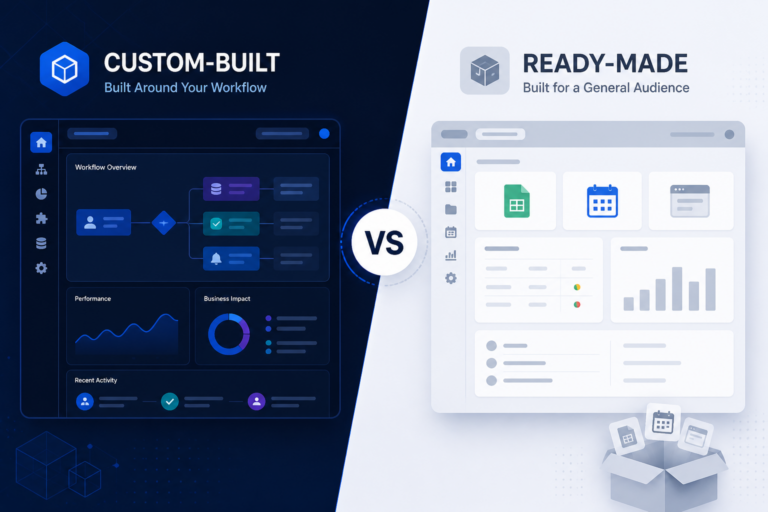
Custom software is worth it when the workflow is the product. It is wasteful when a subscription tool already does the job. If you are still on that fence, start with our article on custom versus off-the-shelf software, then talk about build cost only for the parts that actually need to be custom.
How Softlance estimates work
We estimate from requirements, not from a menu of packages that pretend every product is the same size. A typical path is a conversation, a scoped proposal, and a build plan with visible milestones. Website, software, and mobile work can sit in the same programme when they should — see website development and custom software — or stay separate when that is cleaner.
Have a software idea? Talk to Softlance about planning and building your product. Request a free quote or contact us with the problem, the users, and the date you are working toward. We will tell you what is knowable now and what still needs discovery.
Frequently asked questions
Can you quote a price without a detailed brief?
Only as a wide planning range, and even that can mislead. A useful quote needs the users, the first-release jobs, platforms, and integrations. Without those, you are buying a guess.
Why do two agencies quote such different numbers?
They are usually costing different scopes: different design depth, testing, integrations, and what “done†includes. Compare the assumptions, not the bottom line in isolation.
Is an MVP always cheaper than a full product?
It should be, if you protect the scope. An MVP that secretly includes every stakeholder’s wishlist is a full product with a shorter name.
What should we budget after launch?
Plan for hosting, third-party services, and a maintenance bucket. The right size depends on how often the business will change the product — not on a generic percentage.